



Central bank gold accumulation is now a major part of the global reserve story. The World Gold Council reported that central banks added 863 tonnes of gold in 2025, after three straight years of purchases above 1,000 tonnes. 1
That does not mean every country is abandoning the U.S. dollar. It means many monetary authorities are adding more physical gold while the global currency system becomes more divided. The timing matters. IMF COFER data reported $13.14 trillion in total foreign exchange reserves in the fourth quarter of 2025. 2
BRICS has grown beyond its original five members, now including Brazil, Russia, India, China, South Africa, Saudi Arabia, Egypt, the United Arab Emirates, Ethiopia, Indonesia, and Iran. This gives a larger group of economies a platform to discuss trade and reserves outside the traditional Western-led financial order.
For American families, the signal is worth noting: central banks are adding physical gold at a time of currency strain, geopolitical friction, and growing uncertainty. This article explains why that matters, how BRICS expansion fits into the trend, and why some retirement savers are looking more closely at tangible assets for long-term wealth preservation.
Key Takeaways:
- Central bank gold accumulation has become one of the clearest signals that monetary authorities are preparing for a less dollar-centered world.
- BRICS gold reserves matter because the group’s growth gives more countries reason to hold assets that do not depend on one government, one currency, or one banking system.
- Physical gold is valued by central banks because it carries no default risk when held outright, unlike foreign debt securities that depend on the issuing country’s credit and political system.
- The same pressures that concern central banks — national debt, currency strain, sanctions risk, and loss of purchasing power — also matter to American families and retirement savers.
- Physical gold can be highly trusted and widely recognized, but selling it is not instant or cost-free. Dealer availability, authentication, market hours, storage arrangements, and bid-ask spreads can all affect timing and price.
Geopolitical Realignment and the Multi-Polar Currency Shift
The global financial system is still heavily dollar-based. U.S. Treasury securities, dollar settlement, and Western payment channels remain central to global trade. Still, more countries are asking whether their reserves are too dependent on systems they do not fully control.
That concern became more visible after Russia’s 2022 invasion of Ukraine. Brookings noted that the G7, European Union, and Australia’s REPO Task Force estimated frozen Russian reserves at about $280 billion, with other estimates reaching higher. 3
For many governments, the lesson was direct: foreign currency reserves are not only financial assets. They can also become political pressure points.
That is one reason gold has returned to the center of reserve discussions. Physical gold held in national vaults is not another country’s promise to pay. It is not a bond, a bank balance, or a digital ledger entry inside a foreign system.
It is a tangible reserve asset a country can hold under its own control. BRICS expansion adds to this story. As the bloc grows, member states have more reason to discuss settlement tools and reserve assets that are less dependent on the dollar.
That does not mean BRICS has created a working gold-backed currency. It has not. But more countries are thinking about trade, settlement, and reserves in a multi-polar currency landscape.
For a broader overview of BRICS, the U.S. dollar, and physical gold, read BRICS Currency vs. US Dollar: The Rush to Physical Gold.
Physical Bullion Holdings and Reserve Diversification
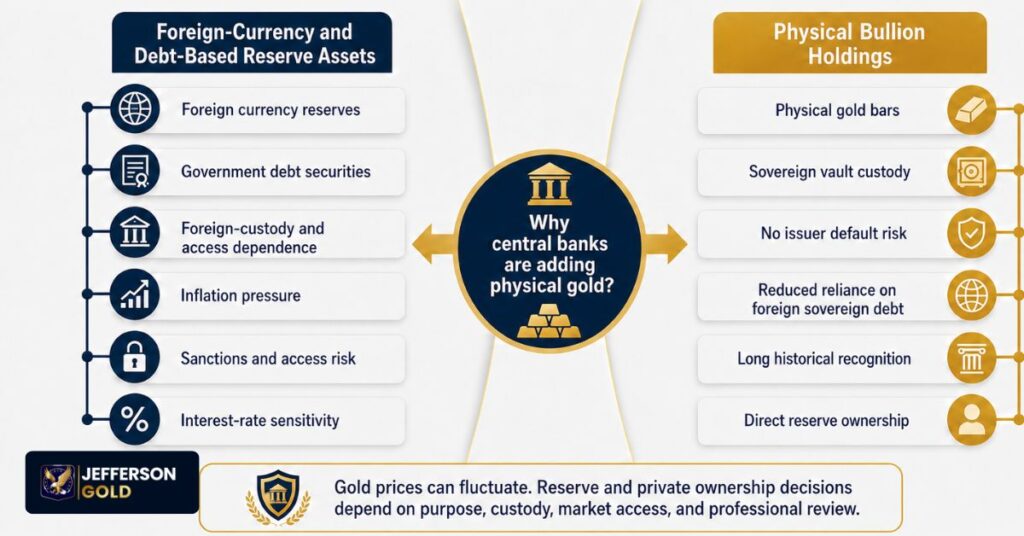
Central banks do not buy gold because it is fashionable. They buy it because physical bullion holdings answer a reserve problem: how can a country hold value without depending entirely on another country’s currency, banking system, or debt market?
Foreign government bonds can be useful reserve assets. But they carry exposure. Their value can move with interest rates. Their repayment depends on the issuing government. Their custody may sit inside a foreign legal and banking structure. In a crisis, access can be affected by sanctions, capital controls, or settlement disruption.
Physical gold is different when it is held outright. It does not depend on a government issuer. It has no coupon, no maturity date, and no default event. It is not someone else’s liability.
The World Gold Council notes that allocated gold held in a bank’s own vault or on an allocated basis has historically received a zero risk weighting under the Basel framework because it does not carry the same credit risk as an unsecured claim on a counterparty. This is a banking-regulation concept and should not be treated as a guarantee against price changes or custody risk.
What Tier One Status Does and Does Not Mean
That does not mean gold is risk-free in price terms. Gold prices can rise or fall. It means physical gold, when properly held, is not exposed to the same default structure as paper debt.
This is the key distinction behind sovereign asset insulation. A central bank that holds foreign debt owns a claim. A central bank that holds physical gold owns an asset.
That difference helps explain the growth in de-dollarization physical gold discussions. Countries do not need to reject the dollar completely to increase gold. They only need to decide that part of their reserves should sit outside the credit and policy choices of another government.
For private buyers, the basic distinction is easy to understand. A bank balance, bond, brokerage statement, or retirement account value is connected to financial institutions and market systems. Physical gold bars and coins are tangible. They can be stored, delivered, verified, and held in a more direct way.
Jefferson Gold helps customers learn about physical precious metals, including options to buy gold for retirement and understand practical asset insulation strategies through physical gold and silver ownership.
Macroeconomic Precedents of Global Currency Friction

Reserve systems do not stay fixed forever. The British pound once held the central role in global finance. Over time, debt pressures, war costs, and changing trade patterns weakened its position.
After World War II, the Bretton Woods system placed the U.S. dollar at the center of global finance, with the dollar linked to gold for foreign governments. That system broke down in 1971 when the United States ended dollar convertibility into gold for foreign official holders.
The lesson is not that every currency change happens the same way. It does not. The lesson is that reserve systems change when economic power, debt burdens, trade patterns, and political trust change.
Why Today’s Currency Friction Matters
Today’s currency friction has several drivers:
- U.S. national debt and fiscal expansion have raised questions about long-term purchasing power.
- Sanctions and reserve freezes have shown that foreign-held paper assets can be affected by political decisions.
- BRICS expansion has given emerging economies a larger platform for settlement systems outside traditional Western channels.
- Central banks have kept adding physical gold even during periods of high gold prices.
The World Gold Council’s 2026 survey found that 89% of respondents expected global official gold reserves to rise over the next 12 months, while 45% expected their own institution’s holdings to increase. The survey also found that 74% expected the U.S. dollar’s share of global reserves to be lower over the next five years. 4
That is not panic. It is preparation. When trust in paper systems becomes less certain, tangible assets become harder to ignore. For readers who want the larger wealth-protection framework, see the master guide: The Ultimate Guide to Protecting Your Wealth in a Volatile Economy.
Parallels in Protection: Protecting Private Retirement Assets

Central banks and families are not the same. A national treasury manages sovereign reserves. A family manages savings, bills, retirement needs, and legacy goals. But the pressures can look familiar.
Why Central Bank Concerns Matter to Families
Central banks worry about currency depreciation. Families experience it as higher grocery bills, insurance costs, property expenses, medical costs, and reduced purchasing power.
Central banks worry about access to foreign reserves. Families worry about whether their savings will hold value through retirement. Central banks worry about debt systems. Families worry about whether paper accounts alone can carry them through a long retirement.
That is why the central bank gold trend matters. It shows that the institutions closest to the monetary system are choosing to hold more of an asset that sits outside default risk and foreign political control.
Private buyers cannot copy a central bank exactly. But they can understand the principle behind the move: holding a portion of wealth in physical assets may help reduce full dependence on paper systems.
Why Physical Gold Appeals to Some Retirement Savers
Physical gold bars and coins may appeal to families because they are:
- Tangible and directly held.
- Recognized across many markets.
- Not issued by a corporation or government borrower.
- Historically used during periods of currency strain.
- Easier to divide and sell in portions than many large physical assets, such as real estate.
That last point needs careful wording. Physical gold has deep global recognition, but individual liquidation depends on real-world steps. A buyer may need dealer review, authentication, settlement processing, shipping or vault procedures, market-hour access, and acceptance of current bid-ask spreads. Gold should not be described as instant cash.
Still, compared with assets that may require listing, inspection, appraisal, financing, escrow, and closing, physical bullion can offer a simpler ownership profile for many buyers.
For retirement savers, this is the heart of the issue: central banks are not adding gold because it pays interest. They are adding it because it can stand outside the paper promises that dominate the modern financial system.
Conclusion
Central bank gold accumulation is one of the strongest monetary signals of the past several years. The world’s reserve managers have continued to add gold amid geopolitical uncertainty, reserve-diversification efforts, debt concerns, sanctions risk, and currency friction. BRICS expansion is part of the broader shift toward a more multipolar economic environment, but it is not the sole explanation for central-bank gold demand.
That does not mean families should make rushed decisions. It means the trend deserves attention. Central banks hold gold because it is tangible, politically neutral, widely recognized, and free from issuer default risk when held outright.
American retirement savers face a smaller version of the same question: how much of their long-term wealth depends on paper systems, and how much is held in assets that exist outside them?
For families concerned about purchasing power, national debt, and long-term financial uncertainty, physical gold and silver may be worth learning about as part of a broader wealth preservation discussion.
To learn more, speak with a Jefferson Gold specialist about available physical gold products, pricing, secure delivery, and storage-related options.