

Florida residents considering a self-directed precious-metals IRA often have two questions. They want to understand how eligible funds can move from an existing IRA or former employer plan into an account holding qualifying physical bullion. They also want to know whether Florida’s recent precious-metals laws change the purchase, documentation, or storage process.
Families researching the Best Gold IRA Companies in Florida should first separate three different systems: federal IRA requirements, Florida’s exemption for qualifying bullion sales, and Florida’s new gold-and-silver legal-tender framework. These systems may involve some of the same metals, but they do not form one combined regulatory program.
Federal rules govern the retirement-account structure and possession requirements. The Florida provisions reviewed in this guide address qualifying bullion sales and a separate state legal-tender system. They do not create a separate Florida Gold IRA or require every Florida account holder to use an in-state vault.
For a clear overview of how self-directed accounts, eligible metals, custodians, and physical storage work together, read Gold IRA 101: Everything You Need to Know About Precious Metals Accounts.
Key Takeaways:
- Effective August 1, 2025, Florida exempted qualifying sales of gold, silver, and platinum bullion regardless of the sales price. The previous version generally required the covered bullion transaction to exceed $500.
- Beginning July 1, 2026, certain forms of gold and silver may qualify as Florida-recognized legal tender. Gold must be at least 99.5% pure and silver at least 99.9% pure, with the required weight and purity markings.
- Florida’s general bullion-sales exemption and its gold-and-silver legal-tender framework are separate. Satisfying one provision does not automatically establish that every requirement under the other provision has been met.
- For qualifying IRA bullion, federal rules require physical possession to remain with a bank or an IRS-approved nonbank trustee. The IRS maintains a current list of approved nonbank trustees and custodians.
- Florida’s detailed in-state security, insurance, recordkeeping, and annual audit standards apply to custodians participating in the state’s gold-and-silver legal-tender system. They are not universal standards for every storage provider serving a Florida IRA account holder.
How Florida’s Bullion Rules Have Changed

Florida now provides a sales-and-use-tax exemption for qualifying gold, silver, and platinum bullion without a minimum purchase amount. A separate law recognizes certain marked gold and silver forms as state legal tender. Neither provision replaces federal IRA rules governing account administration, eligible metals, transfers, or physical possession.
House Bill 7031 And the Removal of the $500 Threshold
Florida Department of Revenue TIP 25A01-03 states that sales of gold, silver, and platinum bullion became exempt from Florida sales and use tax on August 1, 2025, regardless of sales price. Current Section 212.08(7)(ww) states that the sale of gold, silver, platinum bullion, or any combination of those metals in a single transaction is exempt. 1 2
Before House Bill 7031, the exemption generally applied when the covered bullion sales price exceeded $500. The Florida House final analysis explains that the legislation removed that threshold. 3
The exemption is written specifically for gold, silver, and platinum bullion. It should not be treated as a blanket rule for jewelry, collectibles, fabricated products, or every item containing precious metal. Different products may be treated differently under Florida’s rules. Buyers and sellers should confirm how the exact item and transaction are classified.
For Sunshine State physical gold purchases, the central question is not simply whether the buyer lives in Florida. The rule that applies may depend on the product and the details of the transaction. Customers should confirm how the rule applies to their circumstances with qualified professionals.
Section 215.986 Florida Statutes and the July 1, 2026 Rules
Section 215.986 defines qualifying gold as a solid form of gold that is at least 99.5% pure and qualifying silver as at least 99.9% pure. Covered forms can include rounds, bars, ingots, and bullion coins valued for their metal content and marked with their weight and purity. Jewelry, utility items, and collectibles are excluded from these definitions. 4
Qualifying gold and silver are recognized as Florida legal tender for the payment of debts incurred on or after July 1, 2026. Acceptance remains voluntary unless a contract states otherwise, and the law does not restrict the continued use of Federal Reserve notes. 5
House Bill 1311 completed the required rule-ratification process. The bill took effect June 11, 2026, and the Florida Senate records it as Chapter 2026-132 on June 12, 2026.6 These rules govern Florida’s state legal-tender framework. They should not be confused with the separate federal standards that determine which coins or bullion may be held through an IRA.
Purity Records and Florida Department of Revenue Documentation
For the legal-tender exemption, Section 212.05 places the burden on the person claiming the exemption to determine whether the gold or silver meets Section 215.986. In the absence of contrary evidence, the statute creates a presumption based on the purity stamped on the item or a qualifying electronic transfer. 7
Florida Administrative Rule 12A-1.0371 is the Department of Revenue’s adopted rule addressing sales of coins, currency, or bullion. The current rule version took effect December 29, 2025. 8
These provisions should not be described as a special Florida Department of Revenue certification program for IRA custody transfers. The cited laws also do not establish recurring Department-conducted physical counts of private IRA vaults.
For practical account coordination, a records file may include:
- The seller’s invoice
- The custodian’s instructions
- Product descriptions and quantities
- Payment confirmation
- Shipping and delivery records
- The storage provider’s receipt
- Available bar, serial, or lot information
- Periodic account or inventory statements
The exact records required depend on the transaction, the account administrator, the seller, and the storage agreement.
How to Verify Physical Storage for a Florida Gold IRA
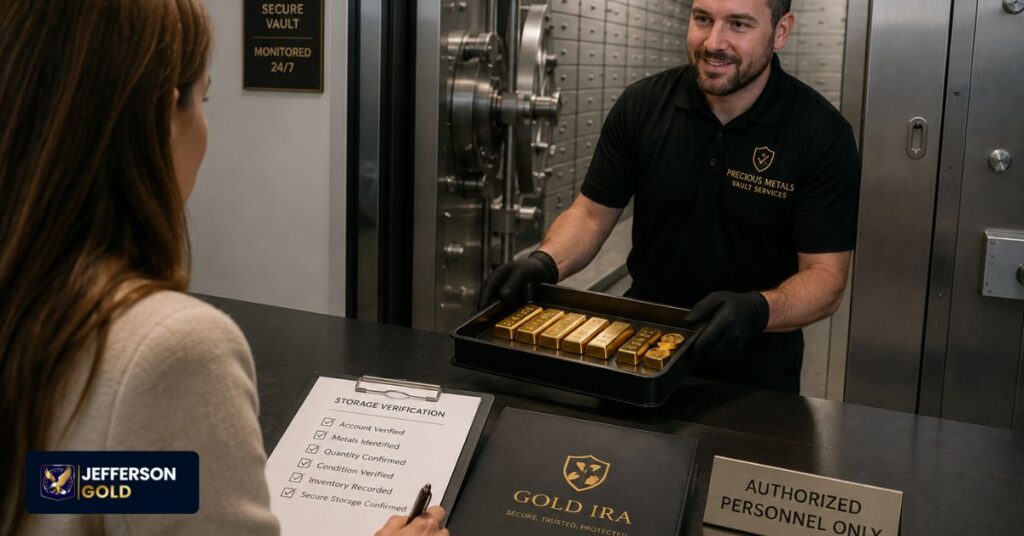
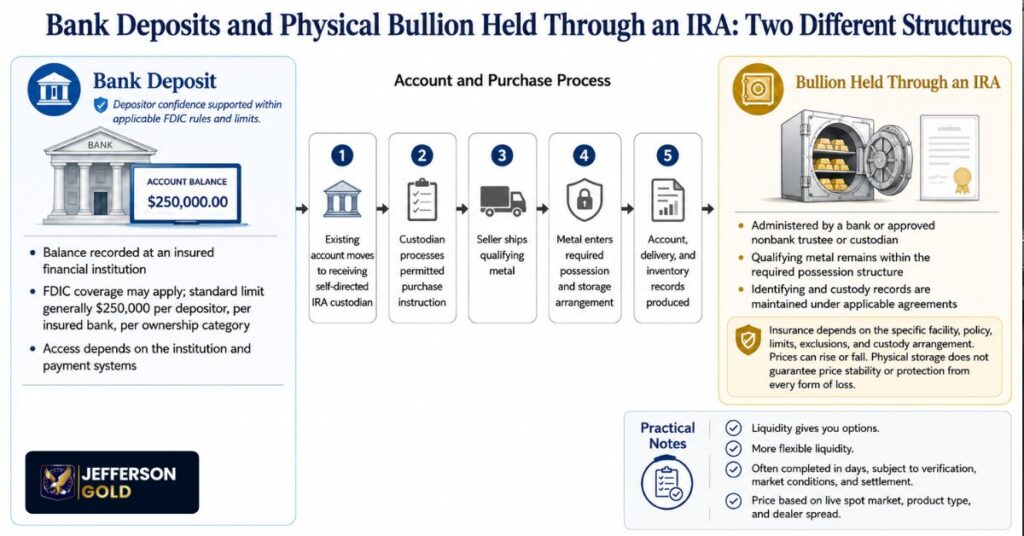
A Gold IRA separates account administration from physical storage. A bank or approved nonbank trustee or custodian maintains the account, while qualifying metal must remain within the required possession arrangement. Florida’s legal-tender custodian rules apply only when a facility falls within that separate state framework.
Self-Directed Custodian Administration and Physical Storage
A self-directed custodian or trustee handles the account’s administrative functions, which may include paperwork, reporting, receiving funds, and processing permitted instructions. Product availability and storage procedures should be confirmed before a purchase is authorized.
The IRS states that certain qualifying bullion is excluded from the collectible rules when a bank or approved nonbank trustee maintains physical possession of it. 9 The IRS also publishes and updates a list of approved nonbank trustees and custodians under Treasury Regulation Section 1.408-2(e). The current list is dated April 1, 2026. 10
The IRS list covers approved nonbank trustees and custodians. It should not be presented as a universal list of “IRS-approved depositories” or as proof that every vault marketed for precious metals automatically satisfies an IRA arrangement.
A typical purchase and storage process may involve the following:
- The receiving custodian confirms that the account is funded.
- The account holder reviews eligible products and applicable storage terms.
- A purchase instruction is processed through the custodian’s procedures.
- The seller ships the qualifying metal to the designated storage arrangement.
- Delivery and inventory records are added to the account file.
The seller, account custodian, carrier, and storage provider have different responsibilities. Customers should confirm each party’s role in writing.
Florida Legal-Tender Custodians vs. Gold IRA Storage Providers
Section 560.214 sets detailed requirements for custodians participating in Florida’s gold-and-silver legal-tender system. These include a high-security vault rated by an approved private testing company, continuous surveillance, biometric or multifactor access controls, inventory tracking, annual independent examination or audit, cybersecurity reviews, and insurance covering 100% of the stored metal’s full replacement value for specified losses. 11
The statute also requires covered holdings to remain within Florida, be held on a fully allocated basis as defined by the statute, and be supported by chain-of-custody and inventory records.
Those requirements apply to custodians covered by Section 560.214. They should not be represented as automatic requirements for every out-of-state or in-state facility used in connection with an IRA.
Nothing in the federal possession rule or the Florida provisions reviewed here creates a universal requirement that every Florida resident’s IRA bullion be stored in Miami, Tampa, or elsewhere within Florida.
Readers seeking broader context on why some families consider physical metals as a way to safeguard what they have built can review Jefferson Gold’s guide to why buyers consider physical precious metals.
How to Evaluate Vault Security Claims
A marketing phrase is not the same as a recognized vault standard. Customers should ask which component was tested, which organization performed the test, what classification was awarded, and whether a current certificate or listing can be provided.
UL 608 covers burglary-resistant vault doors and modular panels. Under the standard, a Class 3 rating represents two hours of net working time against specified mechanical tools, electric tools, cutting torches, or combinations of those methods. 12
A UL 608 rating applies to the rated door or modular component, not automatically to every security feature, operating procedure, insurance policy, or custody arrangement at the facility.
Florida Section 560.214 requires covered legal-tender custodians to use a high-security vault rated by a reputable private security testing company approved by the relevant state office. It does not state that every Gold IRA facility must carry a UL Class 3 designation.
Allocated and Segregated Storage Comparison
Providers may define “allocated” and “segregated” differently. The written storage agreement should control the meaning rather than the marketing label alone.
| Review Point | Allocated Storage | Segregated Storage | What To Confirm |
| Account Identification | Metal Or a Stated Quantity Is Assigned Under the Applicable Agreement | Assigned Metal Is Also Maintained in a Separately Identified Container or Area | Product, Weight, Quantity, Serial, or Lot Details |
| Physical Separation | A Separate Compartment May Not Be Promised | Usually Includes a Separate Container or Defined Space | The Facility’s Written Meaning of “Segregated.” |
| Return Of the Same Items | Depends on the Agreement | More Commonly Expected | Whether the Same Bars or Coins Must Be Returned |
| Insurance Coverage | Depends on the Actual Policy | Depends on the Actual Policy | Carrier, Limits, Exclusions, Deductibles, and Valuation Method |
| Inventory Reviews | Internal or Independent Checks May Apply | Similar Checks May Include Confirmation of Physical Separation | Frequency, Scope, and Access to Completed Reports |
| Withdrawal Process | Controlled by the Account and Storage Agreements | Controlled by the Account and Storage Agreements | Timing, Fees, Identification, Shipping, and Settlement |
| Regulatory Status | Must Be Confirmed for the Specific Arrangement | Must Be Confirmed for the Specific Arrangement | Whether the Facility Participates in Florida’s Legal-Tender System or Operates Under Another Structure |
Miami and Tampa should not be described as confirmed Gold IRA storage hubs without facility-level evidence. A Florida address alone does not establish federal suitability, a specific security rating, full replacement-value insurance, or a standard audit schedule.
How Transfers and Rollovers Work for Florida Account Holders

A direct transfer or direct rollover generally moves eligible funds between institutions without first paying them to the account holder. A 60-day rollover pays the distribution to the individual before it is deposited into another eligible account. The receiving custodian (not the precious-metals seller) handles the account administration.
Direct Transfers and 60-Day Rollovers
In an IRA-to-IRA trustee-to-trustee transfer, the existing trustee sends the funds directly to the receiving trustee. The IRS states that trustee-to-trustee transfers are not subject to the one-rollover-per-year limitation because they are not treated as rollovers.
For an eligible employer plan, the plan administrator may send a direct rollover to the receiving IRA. Federal withholding generally does not apply when the eligible payment goes directly to the receiving plan or IRA.
When an eligible distribution is paid to the individual, the person generally has 60 days to complete the rollover. A retirement-plan distribution paid directly to the individual is generally subject to mandatory 20% federal withholding. Completing a rollover for the full eligible amount may require replacing the withheld portion with funds from another source. 13
A direct movement may reduce the timing and withholding concerns associated with receiving funds personally. It does not establish that every account, distribution, product, or transaction qualifies.
Step-By-Step Account Movement
A careful transfer process helps keep account administration, product approval, shipment, storage, and supporting records coordinated from start to finish.
- Confirm that the current account permits the requested transfer or rollover.
- Open the receiving self-directed IRA.
- Request a trustee-to-trustee transfer or direct rollover when available.
- Confirm that the receiving custodian has posted the funds.
- Review product eligibility and written storage terms.
- Approve the purchase through the custodian’s process.
- Confirm shipment to the approved storage location.
- Keep the account, transfer, purchase, delivery, and inventory records together.
The seller, custodian, carrier, and storage provider have different responsibilities. Account holders should confirm which party handles each stage and request the applicable terms in writing.
Speak With Jefferson Gold
Account paperwork, product eligibility, shipment, and physical storage involve different parties. Jefferson Gold helps customers understand available physical gold and silver products, purchase procedures, delivery coordination, and storage-related considerations. For IRA-held metals, the receiving custodian remains responsible for account administration.
Florida residents can contact Jefferson Gold or call 1-855-994-4562 to ask about available products, account steps, physical delivery, and storage questions.