


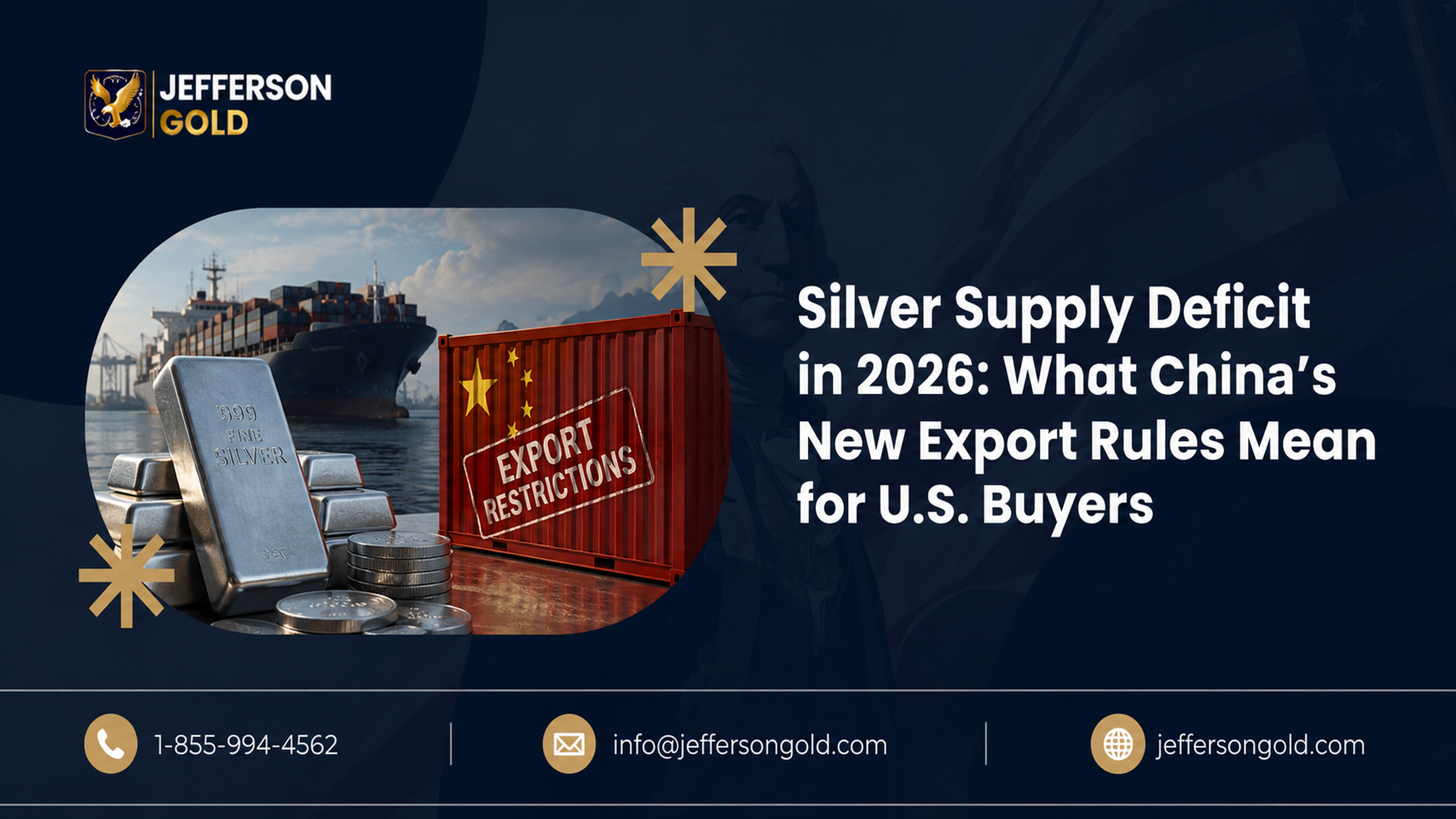
Silver is facing a supply-demand imbalance that has become increasingly important for investors, manufacturers, and buyers of physical precious metals.
According to the Silver Institute’s World Silver Survey 2026, the global silver market is expected to remain in deficit for a sixth consecutive year in 2026, with the projected structural deficit reaching approximately 46.3 million ounces.
At the same time, China has introduced a tighter export licensing framework for silver. For the 2026–2027 period, 44 companies were approved to export silver, adding another variable to an already closely watched global supply chain.
For U.S. buyers, the important question isn’t simply whether silver prices will rise or fall.
It is:
What do a persistent silver supply deficit and China’s new export rules actually mean for the price, availability, and premiums of physical silver in the United States?
The answer involves more than the daily spot price. Mine production, industrial demand, recycling, inventories, international trade flows, investment demand, and physical-market premiums can all influence what buyers ultimately pay for silver.
Why Is the Silver Market Running a Supply Deficit?
A silver supply deficit occurs when total global demand exceeds the amount of silver supplied through mining and recycling.
According to the Silver Institute’s 2026 market outlook, the silver market is expected to record another deficit in 2026, extending the current streak to six consecutive years.
The projected 2026 deficit of approximately 46.3 million ounces represents the difference between expected total supply and demand. It does not mean the world is running out of silver.
Instead, the market is relying on existing above-ground inventories to help bridge the gap between annual supply and demand.
If deficits persist, the amount of readily available metal can become increasingly important to prices, premiums, and physical-market conditions.
Why Can’t Silver Production Increase Quickly?
One of the unusual characteristics of silver is that a significant portion of global production comes as a byproduct of mining other metals, including copper, lead, and zinc.
This makes silver supply relatively difficult to increase quickly.
Even if silver prices rise, miners cannot simply open new silver mines overnight. New mining projects can require years of exploration, permitting, financing, construction, and production ramp-up.
As a result, the supply response to higher silver demand can be slower than investors might expect.
What Is Driving Silver Demand?
Silver occupies a unique position in the precious-metals market because it has both monetary and industrial uses.
Major sources of silver demand include:
- Solar photovoltaic manufacturing
- Electronics
- Electrical components
- Automotive applications
- Industrial equipment
- Medical applications
- Jewelry and silverware
- Physical investment
- Other investment products
Industrial demand is particularly important because silver has properties that make it valuable for electrical and technological applications.
Solar manufacturing has become one of the major sources of industrial silver demand, while electrification, electronics, automotive technology, and other advanced manufacturing applications continue to influence consumption.
AI infrastructure may also contribute indirectly through demand for electronics, power systems, and data-center equipment, although it is only one component of the broader industrial demand picture.
The Silver Institute’s annual surveys track these changes across the major areas of global silver supply and demand.
What Did China Change With Its 2026 Silver Export Rules?
China introduced a new export licensing framework affecting silver exports beginning in 2026.
For the 2026–2027 period, 44 companies were approved to export silver.
This is an important distinction:
China’s new rules should not be described as a complete silver export ban.
The policy establishes an export-licensing framework and determines which companies are eligible to export under the applicable requirements.
China’s Ministry of Commerce has also stated that its export-control measures are intended to be implemented in a prudent and moderate manner rather than functioning as blanket restrictions on all exports.
That distinction matters when evaluating the potential effect on the international silver market.
Why Does the Number of Authorized Exporters Matter?
The number of companies authorized to export silver can influence how the metal moves through international markets.
However, the number of approved exporters alone does not tell us how much silver will ultimately be exported.
Actual export volumes, domestic demand, international demand, inventories, and pricing will be more important indicators of the policy’s real-world effect.
This is why buyers should be careful with headlines describing China’s policy simply as a “silver ban.”
The more accurate description is tighter government control over silver exports through licensing requirements.
Why China’s Silver Policy Matters to the Global Market
China is an important participant in the global metals supply chain.
When a major market introduces additional licensing requirements for a commodity that already has tight supply-demand fundamentals, international buyers naturally pay closer attention to the movement of physical metal.
The effect does not necessarily have to be an immediate global shortage.
Instead, changes in export flows can contribute to:
- Regional differences in physical premiums
- Changes in inventory levels
- Shifts in international trade flows
- Greater uncertainty around future supply
- Increased market volatility
The ultimate impact will depend on how much silver China continues to export and how other producers, refiners, and buyers respond.
How Could China’s Export Rules Affect Silver Prices?
There is no guaranteed price outcome.
Silver prices are influenced by many factors, including:
- Industrial demand
- Investment demand
- Mine production
- Recycling
- Above-ground inventories
- Interest rates
- The U.S. dollar
- Gold prices
- Global economic conditions
- Geopolitical developments
- Physical-market premiums
Tighter export controls could become a supportive factor for silver prices if they materially reduce internationally available supply while demand remains strong.
But that does not mean the policy alone determines where silver prices will go.
For investors, it is more useful to view China’s export rules as one potential supply-side pressure within a much larger silver market.
Why Physical Silver Can Cost More Than the Spot Price
For buyers of physical silver, the spot price is only one part of the final purchase price.
Physical silver products normally carry a premium over the underlying market price.
That premium can reflect:
- Refining costs
- Fabrication costs
- Minting costs
- Dealer inventory
- Product availability
- Shipping and insurance
- Market demand
- Coin or bar size
- Brand or refiner
This creates an important distinction between the silver spot price and the price of a specific physical silver product.
What Happens When Physical Supply Gets Tight?
When demand for physical products rises faster than dealers, refiners, or mints can replenish inventory, premiums can increase.
The effect can vary considerably by product.
Popular one-ounce coins and smaller bars may experience different availability and premiums than larger investment bars.
For this reason, someone purchasing physical silver should look at the total price relative to spot, rather than focusing only on the quoted spot price.
What Does the Silver Supply Deficit Mean for U.S. Buyers?

For U.S. buyers, the biggest practical question is not whether China will suddenly stop supplying silver to America.
The U.S. market has multiple sources of silver, including domestic and international mining, refining, wholesaling, and distribution networks.
Instead, the potential impact is more subtle.
Physical Silver Premiums Can Become More Volatile
If global physical supply becomes tighter while demand remains elevated, premiums can rise.
The effect may be particularly noticeable for popular retail products that require additional fabrication and minting capacity.
Product Availability Can Change
Not every type of silver product responds to market pressure in the same way.
One-ounce coins, fractional coins, rounds, and large bars can experience different levels of demand and availability.
A buyer may therefore find that one product is readily available while another carries a significantly higher premium or temporarily becomes harder to source.
The Spot Price Doesn’t Tell the Entire Story
For someone buying physical silver, the relevant question is not simply:
“What is silver trading at today?”
It is:
“What is the all-in price of the specific silver product I want to purchase?”
That distinction becomes particularly important when physical-market premiums are changing quickly.
Why the U.S. Now Classifies Silver as a Critical Mineral
Silver’s industrial importance has also received greater attention from the U.S. government.
In November 2025, the U.S. Geological Survey announced the final 2025 List of Critical Minerals, adding silver among 10 newly included minerals. The updated list contains 60 critical minerals in total.
The U.S. Geological Survey describes critical minerals as materials important to the U.S. economy, infrastructure, national security, and other strategic needs.
Silver’s inclusion highlights its importance beyond its traditional role as a precious metal.
It is used in areas such as electrical systems, electronics, solar technology, and other industrial applications.
This does not mean that the United States is experiencing a complete silver shortage.
Rather, it demonstrates why reliable silver supply has become an important consideration for U.S. policymakers and manufacturers.
Is Physical Silver Worth Considering in 2026?
There is no universal answer.
Silver can play a different role from gold because it combines precious-metal characteristics with substantial industrial demand.
That combination can also make silver more volatile than gold.
Before purchasing physical silver, buyers should consider:
- Investment objectives
- Time horizon
- Risk tolerance
- Premium over spot
- Storage requirements
- Insurance
- Liquidity needs
- Product size and type
- Existing precious-metals exposure
A persistent supply deficit may be one factor worth monitoring, but it should not be treated as a guarantee of future price performance.
For investors interested in the broader role of precious metals, Jefferson Gold’s Why Invest in Gold IRA and Gold IRA 101 guides provide additional information.
Physical Silver vs. Silver in a Precious Metals IRA
Investors considering silver generally have two different ownership approaches to evaluate: purchasing physical silver directly or holding eligible silver through a Precious Metals IRA.
Buying Physical Silver
Direct physical ownership allows the buyer to purchase specific coins or bars.
Important considerations include:
- Product premiums
- Storage
- Insurance
- Delivery
- Liquidity
- Dealer policies
Jefferson Gold offers several physical silver formats, including 1/10 oz Silver Coins, 1/2 oz Silver Coins, 1 oz Silver Coins and Bars, and 100 oz Silver Bars.
Holding Silver Through a Precious Metals IRA
A Precious Metals IRA provides a different ownership and custody structure.
Eligible metals must satisfy applicable requirements and remain under the custody arrangements required for the retirement account.
Investors considering this route should understand the custodian, eligible products, storage arrangements, fees, and distribution rules before purchasing.
Jefferson Gold’s Gold IRA 101 guide provides additional information about Precious Metals IRAs.
How to Buy Silver Through Jefferson Gold
Jefferson Gold offers physical silver in several sizes and formats for buyers who want to explore tangible precious-metal ownership.
Available options include:
- 1/10 oz Silver Coins
- 1/2 oz Silver Coins
- 1 oz Silver Coins and Bars
- 100 oz Silver Bars
- Silver Products
If you’re comparing different formats, Jefferson Gold’s What to Buy guide can help explain the differences between common precious-metals products.
For the purchasing process, see How to Buy.
For investors considering precious metals within a retirement account, additional information is available through Jefferson Gold’s IRA Forms page.
What Should Buyers Watch Next?
China’s export rules are only one part of the silver supply equation.
Investors and physical buyers should also monitor several other factors.
Global Mine Production
If mine production increases, some pressure from the supply deficit could ease.
However, because silver is frequently produced as a byproduct, production may not respond quickly to higher prices.
Recycling
Recycling provides an additional source of silver supply.
Higher silver prices can encourage more recycling activity, potentially increasing the amount of secondary metal available to the market.
Industrial Demand
Solar, electronics, automotive, and other industrial applications will continue to influence silver demand.
Changes in manufacturing technology can also affect how much silver is required per unit of production.
Investment Demand
Investment demand can change rapidly.
Periods of economic uncertainty, inflation concerns, currency movements, or rising precious-metals prices can encourage additional demand for physical silver and other investment products.
China’s Actual Export Flows
One of the most important things to watch is how China’s new licensing framework affects actual silver export volumes.
The number of authorized companies provides useful context, but actual shipments will provide a clearer indication of whether the policy is materially changing the international supply of silver.
The Bottom Line
The silver market entered 2026 with several important factors working together: strong industrial demand, a projected sixth consecutive annual supply deficit, and increasing attention on the security of global mineral supply chains.
China’s new export licensing framework adds another variable to that environment.
It is important, however, to distinguish export controls from an outright export ban. China approved 44 companies to export silver during the 2026–2027 period, meaning the actual effect of the policy will depend heavily on future export volumes and international market conditions.
For U.S. buyers, the practical issue is therefore not simply whether silver will reach a particular price.
It is whether continued demand, limited production flexibility, inventory conditions, and international trade flows will affect the availability and premium of physical silver.
If you’re considering physical silver or exploring precious metals for a retirement account, understanding the product, premium, custody structure, and risks is just as important as following the spot price.
To discuss available silver products, current pricing, or Precious Metals IRA options, contact Jefferson Gold or call 1-855-994-4562.