



For families who want to buy physical gold in Texas through an IRA, selecting the metal is only one part of the process. The account custodian, precious metals company, carrier, and storage facility must follow a documented chain of custody.
Texas has two prominent but different storage models: the state-administered Texas Bullion Depository in Leander and the privately operated Texas Precious Metals Depository in Shiner.
Both publish extensive security controls, but they differ in government oversight, operating structure, account relationships, auditing, and insurance disclosures.
Key Takeaways:
- Qualifying IRA bullion generally must remain in the physical possession of a bank or an IRS-approved nonbank trustee.
- Lone Star Tangible Assets, the operator of the Texas Bullion Depository, appears on the current IRS list of approved nonbank trustees.
- The Texas Bullion Depository identifies Equity Trust Company as its first IRA custodian relationship.
- Before selecting a facility, account holders should confirm custodian acceptance, segregated storage, insurance terms, fees, shipment procedures, withdrawal rules, and account agreements.
What Top Gold IRA Companies in Texas Should Explain About Storage
Texas Gold IRA storage involves three separate roles. The precious-metals company completes the approved sale, the custodian administers the IRA and processes authorized activity, and the depository receives and stores the metal. A Texas address alone is not enough; the custodian must accept the proposed facility and products before shipment.
The precious metals company completes an approved sale. The custodian maintains the IRA records and processes authorized account activity. The depository receives, records, and stores the physical metals.
A Texas address alone does not make a storage arrangement compliant. The custodian must accept both the facility and the proposed products before the metals are purchased and shipped.
For a broader explanation of account structure, eligible products, and custody, read Gold IRA 101: Everything You Need to Know About Precious Metals Accounts.
How Retirement-Eligible Bullion Can Be Stored in Texas
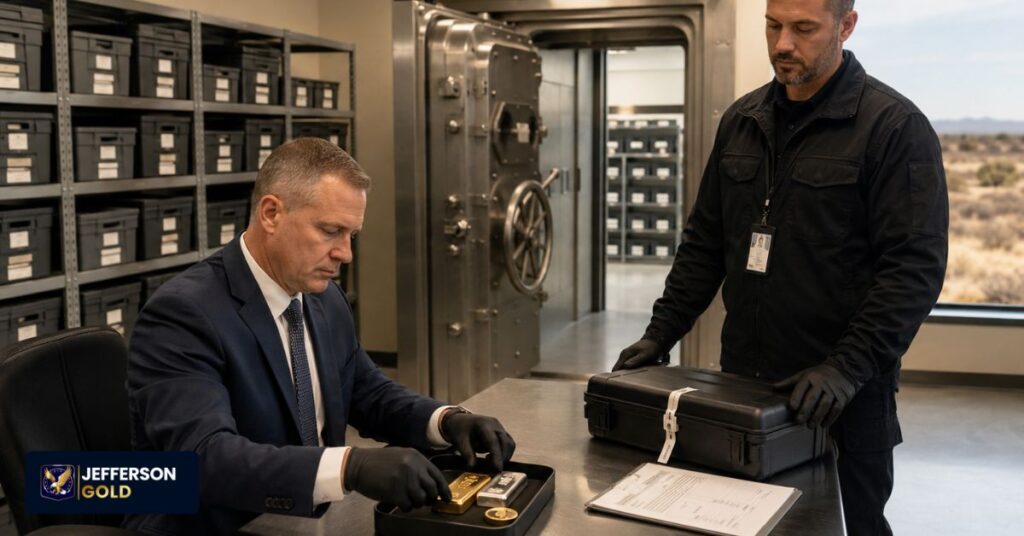
Retirement-eligible physical bullion may be stored in Texas when a bank or an IRS-approved nonbank trustee maintains the required possession and the receiving custodian accepts both the products and storage arrangement. The precious-metals company and carrier must then follow the custodian’s documented payment, delivery, and chain-of-custody procedures.
The IRS generally treats metals and coins as collectibles, subject to limited exceptions. One exception covers qualifying gold, silver, platinum, and palladium bullion when it meets the required standards and remains in the physical possession of a bank or approved nonbank trustee. 1
A home safe should not be treated as a standard IRA storage choice. A personal safe-deposit box controlled by the account holder also should not be assumed to satisfy the federal possession requirement. Taking personal possession may cause the metal to be treated as distributed from the account.
An IRS-approved nonbank trustee is an organization that has shown the IRS that it can administer covered accounts under federal requirements involving continuity, recordkeeping, fiduciary conduct, and control of account property. 2
The current IRS list includes Lone Star Tangible Assets, LP, or LSTA, with an approval date of November 30, 2023.3 LSTA operates the Texas Bullion Depository under contract with the State of Texas.
That approval gives Texas a locally based nonbank trustee option. It does not remove product, custody, reporting, shipment, or withdrawal requirements.
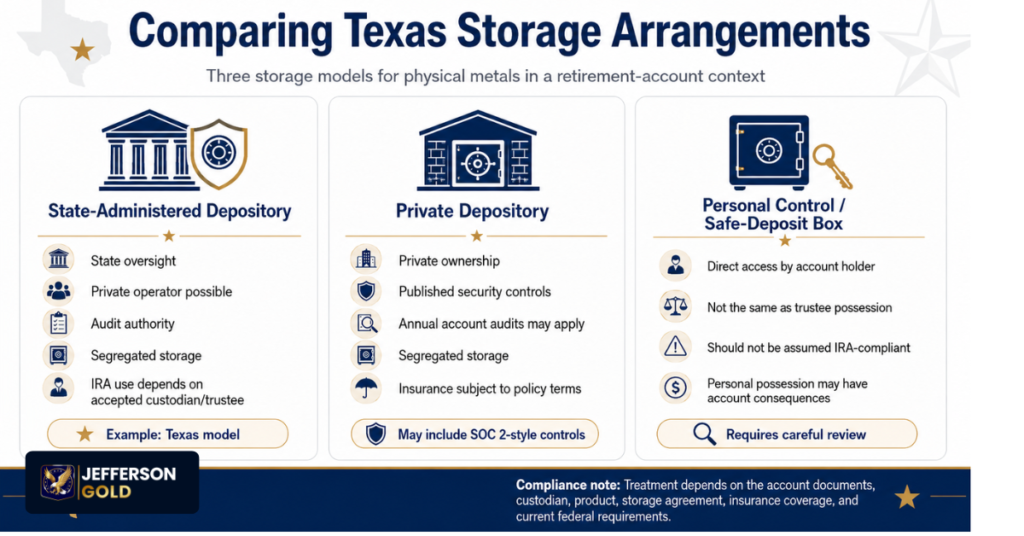
Comparing the Main Texas Depository Models
Texas offers two distinct models for physical bullion storage: a state-administered depository operated under contract with Comptroller oversight, and a privately owned facility that publishes its own security, audit, insurance, and custody controls. Comparing them requires attention to governance, custodian acceptance, contractual terms, and provider-specific disclosures, not location or marketing claims alone.
Texas Bullion Depository in Leander
The Texas Bullion Depository is an agency of the State of Texas under the Texas Comptroller of Public Accounts. Lone Star Tangible Assets operates the facility under a state contract. The Comptroller appoints a Depository Administrator with direct oversight and audit privileges.
An outside Texas accounting firm audits operations on a regular schedule and submits reports to the Comptroller. The depository is also subject to State of Texas audits, although official materials do not publish a fixed monthly, quarterly, or annual interval.
The Comptroller states that the Leander site sits on a purpose-built 10-acre campus about 30 miles north of Austin. Depository holdings are stored in a Class III vault, and the facility currently provides segregated storage. After an authorized withdrawal, the same submitted items are returned to the account holder. 4
The Comptroller also reports coverage for the full metal-content value of account-holder assets through the Lloyd’s insurance marketplace.
The depository’s current website describes the building as a 40,000-plus-square-foot facility with 24/7 monitoring, intrusion detection, controlled access, and on-site security personnel, including commissioned police officers. 5
These are operational statements published by the depository rather than findings from an independent security review.
The Texas Bullion Depository currently identifies Equity Trust Company as the first custodian working with its IRA storage program. It states that more custodial relationships may be added. 6
Texas Precious Metals Depository in Shiner
Texas Precious Metals Depository, or TPMD, is a privately owned facility. It is not an agency of the State of Texas and should not be confused with the Texas Bullion Depository.
TPMD reports that its Shiner facility contains more than 54,000 square feet and uses backup generators, direct alarm feeds to nearby law enforcement, dual or triple vault controls, and full-time security personnel.
TPMD states that its depository and vault controls meet the AICPA Trust Services Criteria for Security in connection with SOC 2 reporting. According to TPMD, customer metals are fully segregated, vault access requires more than one authorized person, and packages are recorded when opened, inspected, audited, or prepared for shipment. 7
TPMD also reports all-risks coverage for full replacement value through underwriters at Lloyd’s, subject to policy exclusions. It describes customer property as being held under a bailment arrangement and separate from TPMD’s balance sheet.
The facility states that customer accounts are audited annually by the San Antonio firm ADKF and that stored values are marked daily against an LBMA reference price. Because these details come from TPMD’s published materials, customers should request current supporting documents before opening an account. 8
Texas Depository Comparison
The table below summarizes the main published differences. It should be read together with each facility’s current agreements and insurance terms.
| Facility Name | Published Security Controls | Auditing Frequency | Insurance Backing |
| Texas Bullion Depository | Class III Vault; Segregated Storage; 24/7 Monitoring | Regular Outside Audits; State Audit Authority | Metal-Content Value Through Lloyd’s Marketplace |
| Texas Precious Metals Depository | SOC 2; Segregated Storage; Dual or Triple Vault Control | Annual Account Audit by ADKF | Replacement-Value Coverage Through Lloyd’s Underwriters |
Security features are only part of the decision. Account holders should also compare custodian acceptance, fees, withdrawal procedures, shipping rules, insurance exclusions, and the terms of the storage agreement.
How Segregated Storage and Bailment Change the Risk Picture
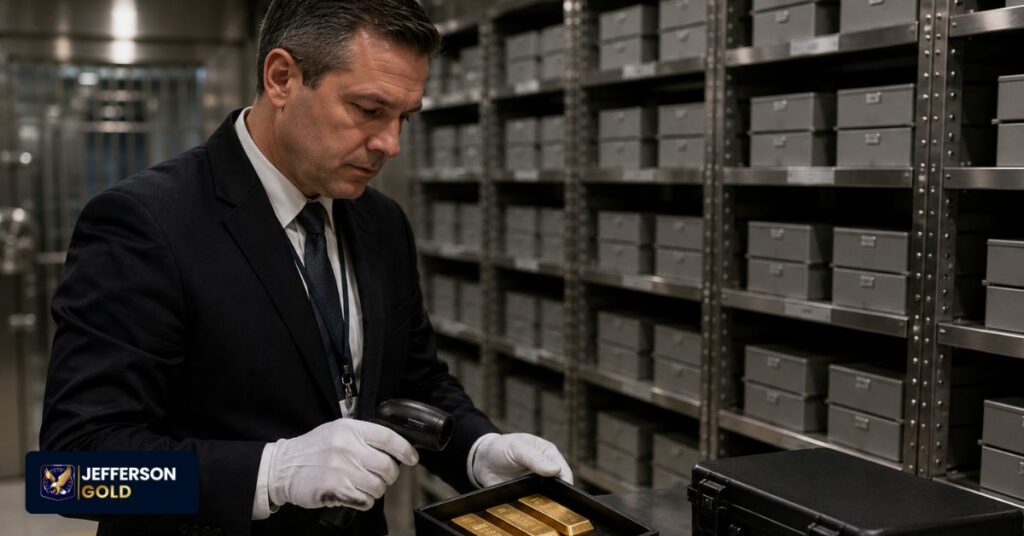
Segregated storage and bailment describe different parts of a storage arrangement. Segregation concerns how specific metal is identified and kept, while bailment describes the provider’s stated relationship to stored property. Neither label removes every operational, contractual, insurance, access, or recordkeeping risk, so the written agreement remains central.
Segregated storage generally means specific bars and coins are identified for a particular account rather than combined into a shared pool. Both the Texas Bullion Depository and TPMD state that their current storage is segregated.
The Texas Bullion Depository says the same deposited items are returned following an authorized withdrawal. TPMD similarly states that customer metals are not commingled.
TPMD describes its storage arrangement as a bailment and states that customer metals remain separate from its balance sheet. The practical and legal effect depends on the signed storage agreement, custody structure, and applicable law. Segregation and bailment may reduce some forms of exposure, but they do not eliminate operational, recordkeeping, insurance, access, or provider risk
For metals inside an IRA, the custodian also controls permitted account activity. Describing those holdings as being in the customer’s direct personal possession would therefore be misleading.
How Physical Metals Reach a Texas Vault
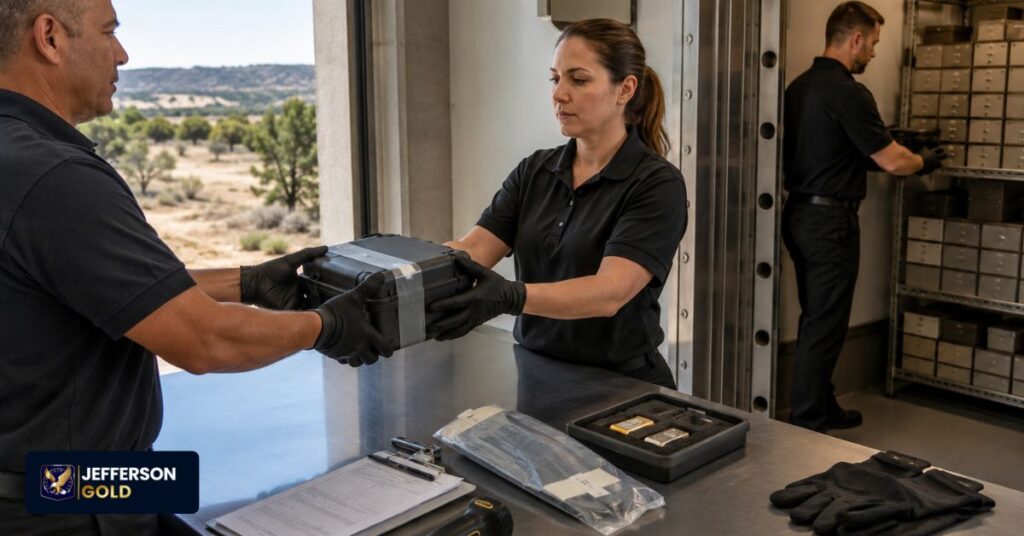
Physical metals held through an IRA generally move through a documented sequence involving the account custodian, precious-metals company, carrier, and accepted depository. The account holder should not personally receive the package. Product approval, payment, transit coverage, shipment instructions, receipt verification, and storage records should be coordinated before the order is released.
Large-volume or wholesale gold bullion in Texas must still follow the custodian’s product-approval, payment, shipment, and storage procedures when held through an IRA.
1. Confirm the Custodian and Account
The account holder first confirms that the custodian permits physical precious metals and accepts the chosen Texas storage facility. Any account-opening or transfer requirements should be completed before a purchase is submitted.
2. Confirm the Product
The custodian should confirm that the proposed bars or coins meet federal requirements and are permitted under its account documents. For more detail on the purchase process, read Jefferson Gold’s guide on how to buy physical precious metals.
3. Submit the Purchase Direction
The account holder gives the custodian a purchase direction identifying the approved products and seller. The custodian then handles payment and records the transaction according to its procedures.
4. Coordinate Direct Shipment
The seller ships the metals directly to the accepted facility under the custodian’s instructions. The account holder does not receive the package. For shipments to the Texas Bullion Depository, published instructions call for nondescript packaging and an internal slip showing the customer’s depository account number.
The facility recommends coverage for the full replacement cost. Tracking information may be supplied, but its instructions describe that step as optional. 9
5. Verify Receipt
After delivery, the depository checks the shipment against the deposit information and records what was received. The Texas Bullion Depository states that it notifies the account holder and, for IRA shipments, confirms the contents with the custodian.
6. Record and Store the Metals
Once the shipment is verified, the depository records and stores the metals under the applicable account arrangement. The custodian then updates the IRA records using the confirmation supplied by the storage facility.
Jefferson Gold’s Role
Jefferson Gold helps customers understand available physical precious metals, compare product options, and coordinate purchases intended for shipment to an accepted Texas storage facility. For IRA-held metals, the custodian and depository remain responsible for the account administration, possession requirements, storage records, and withdrawal procedures.
Before placing an order, customers should confirm that their custodian accepts the chosen Texas facility and proposed products. They should also review who provides transit coverage, who verifies delivery, which party issues account or storage statements, what fees apply, and how withdrawals are handled.
Families interested in why buyers consider physical precious metals may review Jefferson Gold’s educational material before speaking with a specialist.
Check Current Terms Before Opening an Account
Custodial relationships, accepted products, storage charges, insurance policies, shipment rules, and account agreements can change. Readers should confirm current terms directly with the custodian and depository immediately before opening, transferring, funding, purchasing, or shipping. Announced partnerships or proposed arrangements should not be treated as final until the participating organizations confirm them.
As of July 2026, the Texas Bullion Depository’s IRA page identifies Equity Trust Company as its first custodial relationship and states that additional relationships may be added. 10
A proposed partnership, pending measure, new product announcement, or business agreement should not be treated as final until confirmed by the relevant government agency, custodian, and depository.
Speak With a Jefferson Gold Specialist
Choosing a Texas depository involves more than comparing published security controls. The custodian, product, shipment process, insurance terms, and storage agreement must all work together.
A specialist can clarify available products, shipment coordination, and questions to confirm with your custodian.
Before placing an order, contact Jefferson Gold or call 1-855-994-4562 to ask about available products, current pricing, custodian coordination, and shipment to a Texas facility.