



For many American families, war overseas feels distant until it reaches the price of gas, the value of a 401K, the balance of an IRA, or the purchasing power of retirement savings.
The 2026 conflict involving Iran has done exactly that. It has pushed oil routes, bond yields, stock prices, precious metals, and retirement confidence into the same conversation.
For families who want to understand a gold retirement account, physical gold bullion, or direct ownership of precious metals, the key question is not whether one headline will move markets tomorrow. The real question is how global conflict can expose weaknesses inside conventional paper accounts and bank-linked savings structures.
This article explains those mechanics in plain English, with no personal financial direction and no short-term price predictions.
➤ Current context: As of July 2026, U.S.-Iran negotiations and efforts to restore shipping through the Strait of Hormuz remain fragile. This article examines how conflict-related market shocks can affect retirement assets; it does not predict the course of the conflict, oil prices, interest rates, or precious-metals prices.
Macroeconomic Shocks and Paper Asset Volatility

Global conflict can pressure retirement accounts through oil prices, inflation expectations, bond yields, and stock-market stress. When energy routes are threatened, markets may price higher inflation and higher rates, which can hurt both stocks and bonds at the same time. The Iran war is not only a foreign-policy story. It is an energy story, a dollar story, and a retirement-account story.
Goldman Sachs Research reported that, after the conflict began, stocks declined and bond yields spiked, while losses to balanced accounts were still described as limited at that point. Its world portfolio proxy, worth about $300 trillion and representing broad global financial assets, had declined around 5% since the start of the war. 1
Goldman Sachs later noted that oil prices were expected to ease after a reported U.S.-Iran deal, but were unlikely to return to pre-war levels for some time because of lingering conflict effects, low inventories, and Strait of Hormuz uncertainty. 2
That matters for American retirement savers because many 401K, IRA, TSP, 403B, and 457B accounts hold some mix of stocks, bonds, funds, and cash-like products. When conflict pushes oil prices higher, inflation expectations can rise. When inflation expectations rise, interest rates can stay higher for longer. When rates rise quickly, bonds can fall, stocks can reprice, and the “safe” side of a paper account may not feel safe.
This is why protecting family wealth during a geopolitical shock starts with understanding transmission. A conflict overseas can reach a household through fuel prices, grocery prices, bond yields, stock prices, bank confidence, and dollar purchasing power.
For a broader overview of how conflict, debt, inflation, and currency pressure can affect long-term wealth preservation, read Jefferson Gold’s broader guide, The Ultimate Guide to Protecting Your Wealth in a Volatile Economy.
Key Takeaways:
- The Iran conflict has affected retirement accounts mainly through oil prices, interest-rate pressure, stock volatility, and bond-market stress. Goldman Sachs Research reported that stocks declined and bond yields rose after the conflict began, while its world portfolio proxy had declined around 5% at the time of its March 2026 review.
- Goldman Sachs also noted that Iran-related oil disruption risk remained meaningful even after a reported U.S.-Iran deal, with Brent still expected to remain above pre-war levels because of low inventories and supply-risk premiums.
- Precious metals do not always rise immediately during war. Reuters reported on June 1, 2026 that spot gold fell 1% and U.S. gold futures settled 1.9% lower as Middle East tensions raised inflation concerns, the dollar strengthened, and rate expectations stayed firm.
- Short-term gold-price declines during geopolitical shocks can reflect several pressures at once, including dollar strength, oil-driven inflation concerns, and changing interest-rate expectations. These moves do not determine how gold will perform over longer periods or establish a single market explanation.
- A self-directed framework can allow certain approved precious metals to be held inside a qualified retirement structure, but the rules are specific. The IRS states that certain coins and bullion may be excluded from collectible treatment only when requirements are met, including physical possession by a bank or approved non-bank trustee for bullion.
The Mechanical Reality of Institutional Liquidity Cascades
A liquidity cascade can occur when large funds sell assets quickly to raise cash, reduce exposure, or meet collateral demands. During periods of market volatility, this type of selling may affect strong assets as well as weak ones because institutions often sell what is most readily tradable.
Many readers expect gold and silver to rise immediately when war expands. That is not always how modern markets work.
Reuters reported that gold fell on June 1 as Middle East tensions raised inflation concerns, the U.S. dollar strengthened, and traders priced a higher chance of a U.S. rate hike by year-end. 3
A short-term gold-price decline during a geopolitical shock does not establish a single cause or determine how gold will perform over a longer period. In this instance, stronger dollar conditions, higher oil prices, and expectations of tighter monetary policy were among the reported market pressures.
A common sequence looks like this:
| Market Stress Point | What Happens | Why It Can Affect Retirement Accounts | Considerations for Directly Held Bullion |
| Energy Shock | Oil Prices Rise or Remain Unstable | Inflation Expectations and Rate Pressure Can Increase | Physical metals are not tied to oil-company earnings or bond duration |
| Algorithmic De-Risking | Automated Systems Reduce Exposure When Volatility Limits Are Crossed | Stocks, Bonds, Funds, and Commodities May All Face Pressure | Directly held bullion is not managed by a fund model, though its market value can still change. |
| Margin Call Cascade Effects | Leveraged Traders Need Cash to Meet Collateral Demands | Liquid Assets May Be Sold Quickly, Even When the Long-Term Case Remains Intact | Direct ownership does not involve futures-margin exposure, but resale, storage, verification, and settlement still matter. |
| Liquidity-Driven Institutional Sales | Funds Sell Assets That Have Ready Buyers | Paper Metals Exposure Can Dip During a Cash Rush | Directly held bullion may reduce reliance on some market intermediaries, depending on the storage and ownership arrangement. |
| Clearing or Settlement Stress | Payment and Market Systems Face Added Pressure | Access and Settlement Timing Can Become More Important | Direct ownership may reduce some paper-system reliance, depending on storage and account structure |
The World Gold Council reported that global gold-market trading volumes averaged about $424 billion per day in May 2026, indicating that gold remained a large and liquid global market. Liquidity can support buying and selling, but it does not determine future prices or prevent short-term volatility. 4
That depth supports active trading in gold markets, but it does not establish why prices move on any particular day or during a specific geopolitical event.
Physical Gold Bullion vs. Paper Gold During a Cash Rush

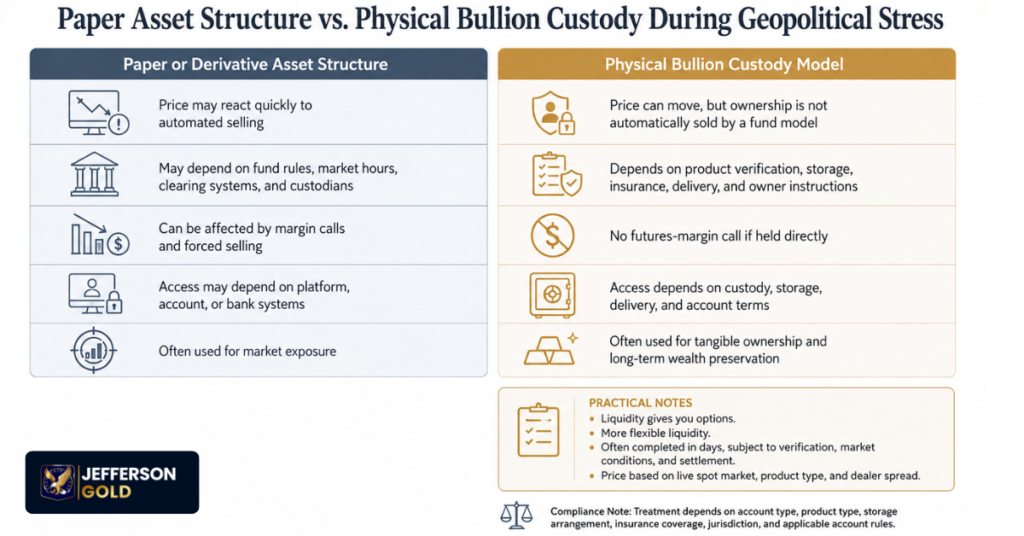
Physical gold bullion and paper gold exposure can share price references, but they are not the same ownership structure. Market-traded gold exposures can involve different contractual, custody, trading, and settlement arrangements. Their risks and mechanics vary by product, so they should not be treated as identical to directly held bullion.
Physical bullion is tangible property, subject to product verification, dealer terms, storage, insurance, shipping, and settlement procedures. That distinction matters during geopolitical stress.
A futures contract or leveraged metals position can move rapidly when margin requirements, trading activity, or fund rules change. Directly held bullion has a different ownership and custody structure and is not part of a futures-margin chain, though its market value can still rise or fall.
That does not make physical metals risk-free. Prices can fluctuate. Dealer spreads matter. Storage terms matter. Delivery timing matters. Product type matters. But the ownership model is different.
For a family trying to protect your wealth across generations, the issue is not only price. It is access, control, and what kind of system the asset depends on.
Paper exposure depends on market infrastructure. Physical precious metals, when purchased directly and stored properly, may reduce reliance on some of those structures.
That is why Jefferson Gold’s asset insulation strategies guide is relevant for buyers who want a plain-English explanation of why families consider physical precious metals during periods of uncertainty.
How Physical Gold Bullion Can Be Held Through a Gold Retirement Account
A gold retirement account is a retirement structure that may hold approved precious metals through a qualified administrative and custody setup. It is not the same as buying coins for home storage, and the rules are specific. This is where the self-directed framework comes in.
A self-directed framework is an administrative structure that allows an account holder to hold certain non-paper assets inside a qualified retirement account through an independent custodian or trustee arrangement. In plain English, it gives the account holder access to a wider set of approved asset types than many conventional retirement platforms offer.
The IRS states that collectibles generally include metals and coins, but certain gold, silver, platinum, or palladium coins and certain bullion may be excluded from collectible treatment under IRC Section 408(m) when specific requirements are met. For bullion, the IRS states that a bank or approved non-bank trustee must keep physical possession of it. 5
That is why details matter. A retirement saver should not assume that any gold coin, rare coin, jewelry item, or privately stored bar fits inside an IRA structure. Product eligibility, custodian process, trustee possession, reporting, and storage arrangements must be handled correctly.
Readers considering retirement-account structures can review Jefferson Gold’s Gold IRA 101 guide to understand the basic terms, questions, and steps involved.
Understanding Retirement-Account and Delivery Options During Market Uncertainty

To secure retirement with precious metals, the focus should be preparation, not prediction. No one can reliably call the next ceasefire headline, oil-price move, Federal Reserve statement, or short-term metals price.
A more grounded approach is to ask practical questions:
- How much of your retirement savings depends on stocks, bonds, funds, or bank-linked platforms?
- How much depends on the purchasing power of the U.S. dollar over the next 10, 20, or 30 years?
- Do you want part of your savings tied to tangible assets rather than only paper claims?
- Would you prefer direct delivery, account-based precious metals, or both?
- Do you understand storage, verification, fees, spreads, shipping, and settlement procedures?
Jefferson Gold helps customers understand physical gold and silver options, direct delivery, and qualified retirement account pathways. Specialists are available to answer questions about pricing, storage considerations, and account setup support.
For buyers who want the buying process explained in plain language, Jefferson Gold’s direct delivery and account purchase steps resource is the right next reading.
Physical Bullion Access Across the United States
For buyers in Florida, Texas, conservative California communities, and the Midwest, the practical questions are usually similar: how to buy verified physical gold or silver, how direct delivery works, what storage options are available, and how a qualified retirement account process differs from a personal purchase.
Jefferson Gold helps customers ask those questions in plain English. Buyers can review available precious metals products, learn about direct delivery, and discuss account-based precious metals options with a specialist.
For questions about products, pricing, delivery, storage-related details, or Gold IRA education, readers can contact Jefferson Gold.
Why Central-Bank Demand Is Part of the Broader Gold Market Context
Short-term market moves do not erase the broader reserve-management trends reported by central banks and industry research. The World Gold Council’s 2026 Central Bank Gold Reserves Survey found that 89% of respondents expected global official gold reserves to rise over the next 12 months, while a record 45% expected their own institution’s gold holdings to increase. The survey also found that 74% expected the U.S. dollar’s share of global reserves to be lower in five years. 6
This should not be framed as proof of a sudden dollar crisis. It is better understood as evidence that reserve managers are preparing for a different balance of power.
For American families, the lesson is practical. Central-bank reserve decisions reflect long-term institutional objectives, including diversification, liquidity, geopolitical considerations, and the management of different types of risk. Those decisions do not provide a direct template for individual households.
That does not mean a buyer should chase short-term price moves. It means families may wish to understand how physical precious metals differ from bank balances, market-traded exposures, and retirement-account structures before making any purchase decision.
Conclusion
The Iran conflict has reminded American families that retirement security can be affected by events far beyond U.S. borders. A war can move oil. Oil can move inflation expectations. Inflation expectations can move interest rates. Rates can move stocks, bonds, and retirement accounts.
One lesson from 2026 is that precious metals can face short-term pressure during a crisis when broader market conditions, dollar strength, inflation concerns, and interest-rate expectations weigh on prices. That does not cancel the long-term role of physical gold and silver. It clarifies the difference between paper exposure and tangible ownership.
Jefferson Gold helps customers learn about and purchase physical precious metals for direct delivery or qualified retirement account use. For questions about physical gold bullion, silver, Gold IRA education, or storage-related options, readers can contact Jefferson Gold.