



Economic uncertainty can make a lifetime of careful saving feel less secure. Higher living costs, bank failures, public debt, geopolitical conflict, and changes in global payment systems have raised questions about purchasing power and access to family savings.
For families asking how to protect your wealth with gold, the first issue is ownership. A bank deposit, gold kept at home, bullion stored in a private vault, and metal held through a self-directed IRA are different arrangements.
Physical gold offers tangible ownership outside an ordinary bank deposit. Its price can still rise or fall, and delivery, storage, insurance, access, and resale terms all matter. Gold is one possible tool for long-term wealth preservation, not guaranteed protection from economic loss.
Key Takeaways:
- The World Gold Council reports that central banks accumulated an average of about 1,000 tonnes of gold per year over the four years ending in 2025, compared with about 500 tonnes per year during the preceding decade. In its 2026 survey, 89% of respondents expected global official gold reserves to increase, while 45% expected their own holdings to rise.
- Central-bank and other official-institution demand totaled 863.3 tonnes in 2025. Estimated demand reached 243.7 tonnes in the first quarter of 2026, up 3% from the revised figure for the same quarter in 2025.
- The latest monthly data, published in early July 2026, showed publicly reported official reserves increasing by a net 41 tonnes in May. This monthly series differs from the World Gold Council’s estimated quarterly demand figures.
- The European Union’s 2026 banking package broadens the possible use of formal resolution for some smaller banks. It does not remove protection from covered deposits or create a simple new threshold for taking insured customer balances.
- Official BRICS materials reviewed through July 7, 2026 do not establish an operating common currency backed 40% by physical gold. Confirmed work centers on local-currency trade, payment connections, and cross-border settlement systems.
Protect Your Wealth with Gold: Start with the Ownership Structure
Physical gold places property in tangible form outside an ordinary bank deposit. This can reduce dependence on a bank’s repayment promise.
A bank account is built for payroll, transfers, cards, bill payments, and regular access. Physical gold serves a different purpose. It is tangible property with a market price rather than a fixed account balance.
Gold should not replace cash needed for food, housing, health care, insurance, and emergencies. It also does not produce interest. Its price may fall after a purchase, and a later resale offer may be below the original purchase price.
The measured case for physical gold rests on its limited supply, physical form, and recognition across bullion markets. Common bars and coins can be identified by metal, weight, purity, mint, refiner, and, for some products, serial number.
Inflation, Currency Weakness, and the Purchasing Power of Physical Gold

Gold has often served as a long-term store of value because it is scarce, durable, and widely recognized. It may retain purchasing power during some periods of inflation or currency weakness, but results vary by purchase price, holding period, interest rates, and economic conditions.
Inflation reduces the amount of goods and services that money can buy. A bank balance may remain unchanged while food, housing, energy, insurance, and medical care become more expensive.
Gold behaves differently from government-issued currency. No central bank can create additional gold by changing monetary policy. Gold does not move in a fixed relationship with consumer prices, however. It can decline during an inflationary period or rise when reported inflation is moderate.
What the Latest Central-Bank Data Shows
The World Gold Council’s 2026 Central Bank Gold Reserves Survey received 76 responses between February 5 and May 19, 2026. It reported average central-bank accumulation of about 1,000 tonnes per year over the previous four years, compared with about 500 tonnes per year during the preceding decade.
The survey found that:
- 89% expected total global central-bank gold reserves to rise during the next 12 months.
- 45% expected their own institution’s holdings to increase.
- 74% expected the dollar’s share of global reserves to be moderately or significantly lower within five years. 1
These are the views of reserve managers, not guarantees about future purchases, gold prices, or the dollar.
The World Gold Council estimated net purchases by central banks and other official institutions at 863.3 tonnes in 2025. That was below the 1,000-tonne level recorded during each of the previous three years, but above the 2010 to 2021 annual average of 473 tonnes. 2
Its updated first-quarter 2026 data reported 243.7 tonnes, compared with a revised 237.0 tonnes in the first quarter of 2025. Separately, publicly reported official reserves increased by a net 41 tonnes in May 2026. 3 4
The monthly number covers publicly reported changes, while the quarterly figure includes estimates for activity that may not yet have been disclosed. They should not be added together.
Central-bank buying does not tell a family what to do. It shows that gold continues to hold a place in official reserves during periods of economic and geopolitical concern.
Modern Banking Laws and Depositor Bail-In Risks
A bail-in allows a bank-resolution authority to write down certain liabilities or convert them into equity. Covered deposits receive specific protection under the European framework. Other claims may be treated differently based on their ranking and the resolution plan.
When money is placed in an ordinary bank account, the deposit appears as a liability on the bank’s balance sheet. The customer holds a contractual claim for the recorded balance rather than ownership of separately stored currency. 5
In the United States, eligible deposits receive FDIC protection up to $250,000 per depositor, per FDIC-insured bank, for each ownership category. Separate coverage may apply across qualifying ownership categories when FDIC requirements are met. 6
These U.S. protections are meaningful. Insured deposits should not be grouped together with uninsured balances or described as though every account faces the same risk.
How a Bail-In Works Under the BRRD
The Bank Recovery and Resolution Directive, commonly called the BRRD, gives European authorities tools for handling failing banks. Its bail-in tool can write down eligible debt owed by a bank or convert that debt into equity.
Shareholders generally bear losses first. Creditors then bear losses according to their ranking. Covered deposits are fully protected by the applicable deposit-guarantee schemes and are excluded from the bail-in tool. 7
Amounts above the protected deposit limit may be treated differently, but they do not automatically absorb losses before shareholders, capital instruments, and more junior claims.
What the 2026 CMDI Package Changed
Directive (EU) 2026/806, one of the principal measures in the final Crisis Management and Deposit Insurance package, was published in the European Union’s Official Journal on April 20, 2026. 8
The revised framework makes formal resolution more available for certain smaller and medium-sized banks when ordinary insolvency could interrupt important services or threaten financial stability. It also permits greater use of industry-funded deposit-guarantee and resolution resources under defined conditions.
The Council of the European Union stated that the revised framework is intended to reduce reliance on bail-ins of uninsured depositors by giving qualifying smaller banks access to industry-funded safety nets under defined conditions. Covered deposits remain excluded from the BRRD bail-in tool.
Under Directive (EU) 2026/806, member states generally must transpose the relevant measures by May 11, 2028 and apply them from May 12, 2028, although some provisions apply earlier.
The Ashurst review of the final CMDI package provides further detail. The European framework is not U.S. or Canadian law. It shows how one major jurisdiction handles bank failures, but it does not prove that North American accounts would receive identical treatment. 9
For a closer comparison of deposit exposure and physical possession, read Physical Gold vs. Bank Bail-Ins (2026 Outlook).
Bank Deposits and Physical Bullion Compared
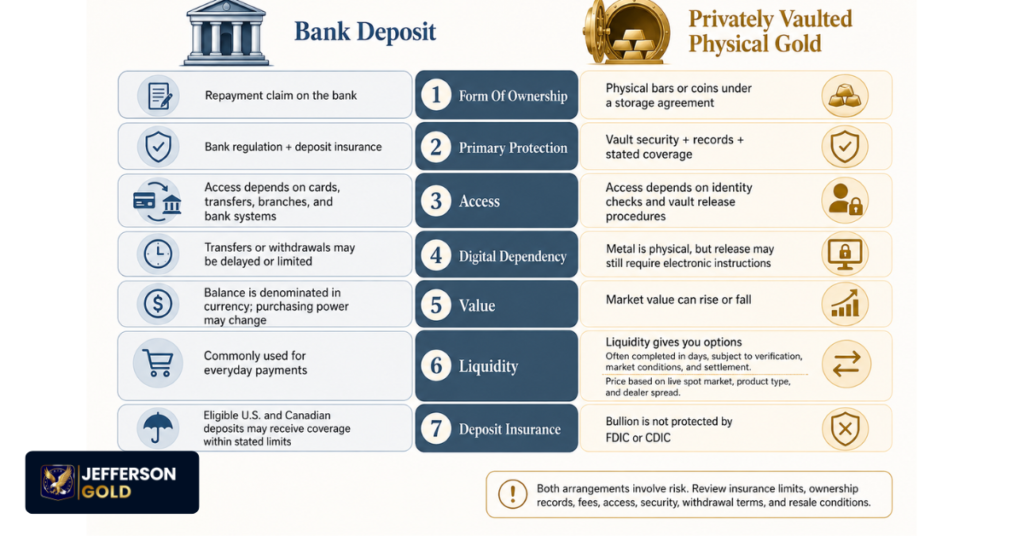
This comparison shows how bank deposits and physical bullion differ in ownership, access, insurance, liquidity, and exposure to service providers.
| Review Point | Commercial Bank Deposit | Home-Held or Privately Vaulted Bullion |
| Form of Ownership | Contractual Repayment Claim Recorded as a Bank Liability | Direct Possession at Home, or Rights Defined by a Storage Agreement |
| Primary Protection | Bank Regulation and Applicable Deposit Insurance | Physical Safeguards, Records, and any Coverage Stated in the Agreement |
| Service-Provider Exposure | The Bank and Payment System | Seller, Carrier, Vault Operator, Insurer, and Verification Provider |
| Access During Disruption | May Depend on Cards, Branches, Transfers, and Bank Systems | Home Access Depends on the Owner’s Storage and Security Arrangements; Vault Access Depends on Release Procedures |
| Digital Limits | Transfers or Withdrawals May Be Delayed or Limited | Vaulted Release May Still Require Electronic Instructions |
| Price Behavior | Balance Is Denominated in Currency, While Purchasing Power May Change | Market Value Can Rise or Fall |
| Liquidity | Commonly Available for Everyday Payments | A Sale Requires Verification, Pricing, a Buyer, and Settlement |
| Deposit Insurance | FDIC Coverage May Apply Within Stated Limits | FDIC Does Not Cover Bullion |
Physical bullion does not remove every risk. Metal kept at home may be exposed to theft, fire, loss, and personal-security concerns. Privately stored metal depends on the vault’s records, security, coverage, fees, and withdrawal procedures.
The written storage agreement should state how the metal is identified, assigned, stored, covered, withdrawn, and sold.
The BRICS Unit Claim and What Official Records Show

BRICS officials have supported greater use of local currencies, closer connections among payment systems, and further work on cross-border settlement infrastructure. As of July 7, 2026, the official BRICS declarations and document repositories reviewed for this article contained no announcement of a common settlement currency backed 40% by physical gold.
Fiat currency is government-issued money that is not redeemable for a fixed quantity of gold. A currency can lose purchasing power within its domestic economy, weaken against foreign currencies, or experience both. A new payment route between two countries does not automatically raise U.S. consumer prices or end the dollar’s global role.
What BRICS Has Officially Announced
The 2025 BRICS Rio de Janeiro Declaration discussed local-currency financing, payment-system connections, lower-cost cross-border payments, and further work on settlement infrastructure. It did not announce a gold-backed common currency.
The 2025 BRICS Finance Ministers and Central Bank Governors Joint Statement also discussed cross-border payments and technical work. It did not establish a common currency, a 40% physical-gold reserve rule, an issuing body, a redemption system, or a list of pilot countries.
Brazil’s BRICS Sherpa stated in 2025 that a common BRICS currency was not under discussion. The focus was on local currencies, payment platforms, and reducing transaction costs.
The official BRICS India 2026 site lists eleven members and publishes the group’s current documents and priorities. No official 2026 document reviewed for this article establishes an operating BRICS Unit Prototype. 10
The claim that a BRICS settlement unit has been launched with 40% physical-gold backing is not confirmed by the official BRICS materials reviewed for this article.
Future agreements could change the position. Until official materials define issuance, governance, reserves, participating countries, settlement rules, and redemption rights, the proposed Unit remains separate from confirmed BRICS payment work.
For more context, read BRICS Currency vs. US Dollar: The Rush to Physical Gold.
Wealth Preservation Through Gold: Benefits and Friction

Physical gold offers tangible ownership and does not depend on a bank deposit for its existence. It may support long-term wealth preservation, but it does not pay interest, remain stable in price, or guarantee protection during every period of economic stress.
Physical bullion can be identified by metal, weight, purity, mint, refiner, and, for some products, serial number. Personally held metal does not depend on a commercial bank’s ability to repay a deposit. Recognized bars and coins can also be presented to bullion dealers for resale.
These features come with costs and limits. Gold prices fluctuate, and a later resale offer may be below the original purchase price. Shipping, insurance, storage, verification, and account charges may apply. Gold does not produce interest or dividends.
Home storage creates concerns involving theft, fire, loss, privacy, and personal security. Private-vault access depends on the provider’s procedures and written terms. Bullion held through an IRA must remain within the required possession arrangement and cannot simply be taken home while it remains inside the account.
Gold is not a guaranteed answer to economic stress, and a bank account is not automatically unsafe. They serve different purposes and carry different risks.
Regional Physical Delivery and Secure Storage
Safe bullion delivery depends on verified products, clear pricing, secure packaging, tracking, shipment coverage, and accurate records. Private storage adds professional security but still depends on written ownership and access terms.
The same basic checks apply whether a customer wants to buy physical gold in Texas, arrange delivery in Florida or California, or receive bullion in the Midwest. Before payment, confirm the product, weight, purity, quantity, full price, dealer spread, tracking process, signature requirements, coverage limits, and claims procedure.
After delivery, inspect the package promptly and keep the invoice, payment confirmation, product details, tracking information, and delivery record together. Customers using a private vault should confirm how the metal is identified, what coverage applies, how access works, and what fees may be charged when the metal is withdrawn or sold.
Jefferson Gold explains its process for secure physical home deliveries. Families focused on long-term ownership can also read how physical precious metals may help safeguard your family.
Holding Qualifying Bullion Through a U.S. IRA
A self-directed precious-metals IRA is not the same as buying gold for personal possession. The IRS states that certain gold, silver, platinum, and palladium bullion may qualify when a bank or approved nonbank trustee keeps physical possession. Personal home possession should not be presented as meeting that requirement. 11
The IRS also maintains a list of approved nonbank trustees and custodians. The current published list is dated April 1, 2026. Inclusion concerns the entity’s trustee or custodian status and should not be described as a universal list of government-approved bullion vaults.
The process generally begins with opening a receiving self-directed IRA through a qualified custodian. The account holder then checks whether an existing IRA, 401K, 403B, 457B, or TSP is eligible for the requested movement.
A direct transfer or direct rollover generally sends eligible funds between institutions rather than paying them to the account holder. When an eligible employer-plan distribution is paid to the individual, a 60-day rollover period generally applies, and the plan generally withholds 20% of the taxable amount. Mandatory withholding does not apply to a direct rollover. 12
Account type, plan terms, timing, age, and eligibility can affect the result. An account movement should not be described as automatically penalty-free.
Jefferson Gold’s Gold IRA 101 guide explains how the seller, custodian, and physical storage provider fit into the account process.
Speak With Jefferson Gold
Protecting what a family has built starts with accurate information, clear ownership terms, and a realistic understanding of risk.
Jefferson Gold can answer questions about available physical gold and silver products, pricing, delivery, storage choices, and precious-metals IRA purchase procedures. The receiving custodian remains responsible for administering an IRA.
To ask about current products or account procedures, contact Jefferson Gold or call 1-855-994-4562.