


Inflation changes the cost of ownership. As prices rise and borrowing becomes more expensive, many American families begin looking more closely at tangible assets that may hold value over time. Real estate and physical gold bars are often discussed together because both are tangible assets, not paper-based holdings. Yet they function very differently once maintenance costs, liquidity timelines, and ongoing expenses enter the picture.
A property may produce rental income and long-term appreciation, but it can also involve repairs, taxes, insurance, financing pressure, and slower sale timelines. Physical gold bars do not generate income, but they are generally easier to divide, simpler to store, and involve fewer ongoing ownership demands.
For retirement savers and wealth preservation buyers, understanding these practical differences matters more during inflationary periods when access to capital and ownership costs can change quickly.
Key Takeaways:
- Physical gold bars are generally easier to liquidate in smaller portions than real estate because bullion holdings are divisible while property assets are not.
- Inflation can increase real estate maintenance costs through rising labor rates, contractor pricing, insurance premiums, and material expenses.
- Comparing liquidity timelines and ownership costs side by side can help buyers understand how different tangible assets behave during periods of economic stress.
Real Estate vs Gold Bars: Core Operational Differences

Liquidity and carrying costs are two of the most important factors when comparing tangible assets during inflationary periods. Liquidity refers to how quickly an asset can be converted into usable cash without major delays or heavy pricing concessions. Carrying costs refer to the ongoing expenses associated with ownership.
For real estate owners, carrying costs can include:
- Property taxes
- Insurance premiums
- Mortgage payments
- HOA fees
- Landscaping
- HVAC repairs
- Plumbing issues
- Roofing replacement
- Property management fees
- Vacancy-related expenses
According to the U.S. Census Bureau, homeowner costs commonly include utilities, insurance, taxes, mortgages, and home loans, showing that property ownership involves recurring operational expenses beyond the original purchase price. 1
Physical gold bars operate differently. Gold bullion does not require structural maintenance, utility payments, contractor labor, or tenant oversight. Its ongoing costs depend on how it is held. Buyers who use professional vaulting or depository storage may pay storage or insurance-related fees, while buyers who keep metals at home may instead need to consider secure storage equipment, insurance coverage, documentation, and personal security practices.
This difference becomes more noticeable during inflationary cycles because inflation often increases labor costs, construction materials, insurance pricing, and repair expenses.
The U.S. Bureau of Labor Statistics defines inflation through the Consumer Price Index, which tracks price changes across goods and services throughout the economy. For property owners, those broader price pressures can show up in repair labor, building materials, insurance, utilities, and household services. 2
Gold also maintains a different liquidity profile. The World Gold Council notes that gold markets generally remain active during periods of financial stress because gold is widely recognized and globally traded. 3
Real Estate Maintenance Costs During Inflation
Real estate has historically attracted buyers seeking long-term appreciation and rental income potential. Under stable conditions, property ownership may support long-term wealth growth and cash flow generation.
At the same time, inflation can significantly increase the cost of maintaining property. Unlike bullion, real estate is an operational asset. Ownership involves ongoing responsibilities regardless of broader market conditions.
Inflation Raises Property Overhead
Inflation can raise the cost of roofing materials, lumber, copper wiring, HVAC replacement, contractor labor, appliance replacement, landscaping services, and insurance premiums.
For rental property owners, these rising expenses can reduce operating margins, particularly when maintenance problems appear unexpectedly. A single plumbing issue, roofing failure, or HVAC replacement can materially change annual ownership costs.
Realtor.com’s 2026 housing forecast notes that high prices and financing costs continue to weigh on homebuyers, while inventory, affordability, and pricing trends vary across the U.S. housing market. 4
Liquidity Friction in Real Estate Transactions
Property sales often take time.
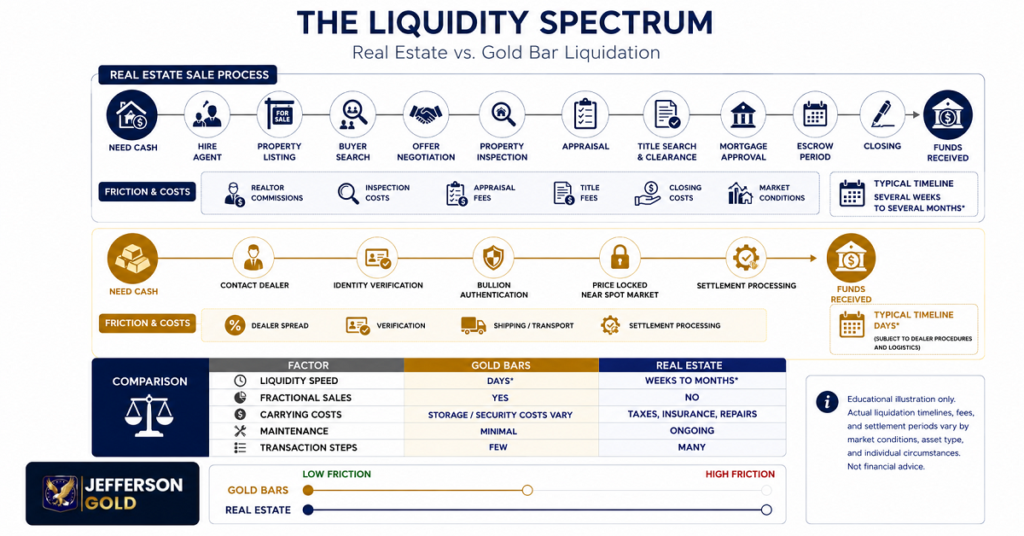
Even during stable market conditions, residential real estate transactions often involve:
- Property preparation
- Listing coordination
- Buyer acquisition
- Offer negotiations
- Property inspections
- Appraisal review
- Title clearance
- Mortgage underwriting
- Escrow processing
- Closing and settlement
During inflationary periods, tighter lending conditions and higher rates can extend these timelines further.
Accessing Capital During Market Stress

Consider a household facing an unexpected liquidity need during a volatile inflationary period. If most available wealth is tied to property holdings, accessing cash may require a multi-stage sales process involving inspections, financing approvals, escrow periods, and broker coordination. During that process, carrying costs continue.
Insurance premiums remain active. Property taxes continue. Repair obligations do not stop simply because the owner intends to sell.
Physical gold bars function differently.
A gold bar owner holding multiple bars may liquidate only a portion of their holdings while keeping the remainder intact. That flexibility does not exist with residential property ownership because real estate assets are not easily divisible.
At the same time, gold liquidation is not instant or cost-free. Settlement timelines can depend on dealer availability, verification procedures, bid-ask spreads, shipping arrangements, market hours, and storage structures.
Still, compared to a typical real estate transaction timeline, physical gold may provide faster access to capital with fewer administrative steps.
Want to learn how physical gold bars may offer lower maintenance demands and more flexible liquidity during inflationary periods? Request the Jefferson Gold Insights Guide to explore bullion products, storage options, and ownership considerations.
Comparative Evaluation Table
The differences between physical gold and real estate become easier to see when both assets are placed side by side. The comparison below focuses on liquidity timelines, carrying costs, transaction friction, and divisibility during inflationary periods.
| Asset Parameter | Physical Gold Bars | Real Estate Assets |
| Liquidity Velocity | Often Completed Within Days (Subject to Dealer Verification & Settlement Procedures) | Often Requires Weeks or Months Depending on Listing, Financing, & Escrow Conditions |
| Carrying Costs | Predictable Fixed Storage / Vaulting Fees | Variable Inflation-Driven Upkeep, Insurance, & Property Taxes |
| Transaction Friction | Standard Dealer Spreads & Secure Transport Fees | High Broker Commissions, Title Fees, & Closing Costs |
| Fractional Divisibility | High (Individual Bars May Be Liquidated Independently) | Low (Property Assets Are Not Easily Divisible) |
Attention: The timelines, fees, and liquidity examples above are educational estimates only. Property costs, dealer spreads, settlement timelines, and vaulting fees can vary based on location, provider, product type, and market conditions.
Physical Gold Bars: Lower Maintenance and Flexible Liquidity

Physical gold bars operate with far fewer operational demands than real estate. Gold does not require tenant management, structural repairs, utility payments, contractor scheduling, plumbing maintenance, roofing replacement, or landscaping oversight.
That simplicity is one reason many wealth preservation buyers continue to view physical gold as a practical store of value during inflationary periods.
Gold Bar Storage Fees
Gold storage costs depend on the custody method. Professional vaulting or depository storage may involve account structures, insurance coverage, and storage provider pricing. Home storage may not involve vaulting fees, but buyers should still consider secure storage equipment, insurance coverage, documentation, and personal security practices.
Some vault providers use flat annual fee structures, while others charge percentage-based storage fees tied to account value.
Although storage fees can vary, gold ownership generally avoids many of the unpredictable repair costs associated with property ownership.
Physical Gold vs Property Ownership
Real estate and physical gold serve different purposes. Real estate may provide rental income potential, long-term appreciation, physical utility, and multi-generational ownership value.
Physical gold may provide easier divisibility, potentially faster access to liquidity, lower maintenance obligations, and a simpler ownership structure with reduced operational overhead.
The right role for each asset depends on the buyer’s timeline, liquidity needs, financial priorities, and long-term goals.
Final Takeaway
Real estate and physical gold both play important roles in long-term wealth preservation discussions, particularly during inflationary periods. Property ownership may provide appreciation potential and rental income, but it also involves ongoing maintenance obligations, financing exposure, and slower sale timelines.
Physical gold bars do not generate recurring income, yet they may offer simpler ownership, lower operational overhead, and easier partial liquidation when access to capital becomes important.
For many American families and retirement savers, understanding these structural differences is more important than treating one asset as universally superior to the other.
Have questions about purchasing physical gold bars or secure storage options? Speak with a Jefferson Gold specialist by phone to learn more about available bullion products, pricing, delivery options, and storage arrangements.